If you want to grow your portfolio without losing returns to fees, low-cost ETFs are one of the smartest starting points for beginner investors. These affordable, diversified funds combine broad market exposure, tax efficiency, and minimal expenses, making them a favorite for both new and experienced investors.
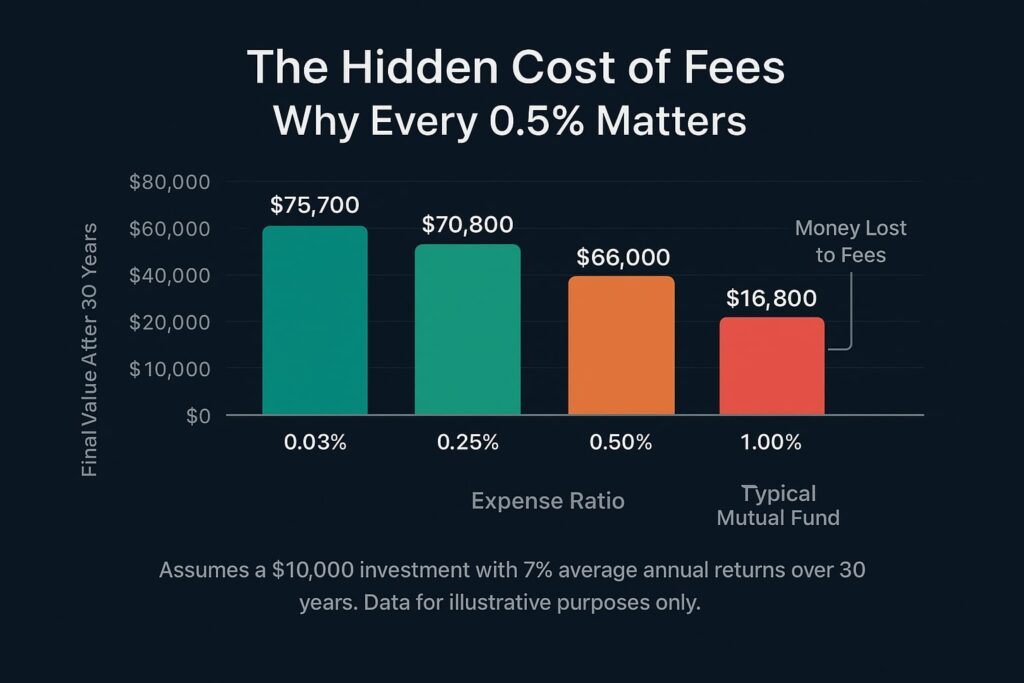
Even a small difference in fees can make a big impact over time — here’s what that looks like in practice.
What Is a Low-Cost ETF?
Low-cost ETFs (exchange-traded funds with low fees) are essentially baskets of stocks, bonds, or other assets that you can buy or sell on the stock market like regular shares. The “low-cost” part refers to the minimal fees you pay compared to traditional mutual funds or some higher-cost ETFs.
Most low-cost ETFs track an index, such as the S&P 500 or a technology sector index. This means you get exposure to a broad range of investments without buying each stock individually.
With annual management fees often under 0.1%, your money works harder for you, not the fund manager. Many investors also appreciate the transparency and simplicity of low-cost ETFs—they aren’t a black box like some actively managed funds.
Why Fees Matter
Fees may seem small, but over time, they can have a big impact.
For example:
- $10,000 invested in a mutual fund with a 1% fee costs $100 per year.
- The same investment in a 0.05% ETF costs only $5 per year.
Over decades, this difference compounds, making low-cost ETFs a powerful tool to maximize returns.
Key takeaway: Tracking expense ratios (the annual cost of owning a fund) is crucial. Lower fees mean your wealth grows faster.
Key Benefits of Low-Cost ETFs
Investors love low-cost ETFs for several reasons:
- Affordability: Lower fees let you keep more of your profits.
- Diversification: One ETF purchase can give you exposure to dozens or even hundreds of companies.
- Tax Efficiency: ETFs generally trigger fewer taxable events than mutual funds.
- Flexibility: Buy or sell shares anytime during market hours, like a regular stock.
Many ETFs also pay dividends, which can be reinvested to boost long-term growth.
Getting Started With Low-Cost ETFs
Getting started is simpler than most people think:
- Open a brokerage account: Most online brokers now offer fee-free ETF trades.
- Set an investment goal: Retirement, house savings, or general wealth growth?
- Do your research: Check which indexes the ETFs track, their managers, and their expense ratios.
- Start small: Many brokers allow fractional shares, so you can invest with just a few dollars.
- Automate contributions: Dollar-cost averaging smooths out market ups and downs.
Types of Low-Cost ETFs
Low-cost ETFs cover a variety of markets and strategies:
- Index ETFs: Track a broad market index (e.g., S&P 500, Nasdaq 100). Most low-cost ETFs are index funds.
- Bond ETFs: Offer steady income with lower risk, usually at minimal fees.
- Sector ETFs: Focus on specific industries like tech, healthcare, or energy.
- International ETFs: Give exposure to global markets beyond your home country.
Index ETFs are great for beginners, while sector and international ETFs allow more customization.
What to Watch Out For
Even low-cost ETFs have things to consider:
- Expense ratio differences: 0.05% vs. 0.1% can add up on large investments.
- Tracking error: How closely the ETF matches its index. Lower is better.
- Liquidity: Choose ETFs with high trading volume to avoid price swings.
- Underlying holdings: Make sure the assets align with your goals.
Do your homework by reading fund fact sheets and checking issuer websites like Vanguard, iShares, or Schwab.
Common Challenges and Questions
- Market volatility: ETFs mirror the market—they won’t protect against downturns.
- Choice overload: Hundreds of ETFs exist, so comparing options can be overwhelming.
- Hidden costs: Watch for bid-ask spreads and broker fees.
Practical Tips for Making the Most of Low-Cost ETFs
- Automate Your Contributions: Many brokers let you set up automatic investments. This is a great way to stick to your plan and “dollar cost average” into the market, which can help smooth out the bumps.
- Reinvest Dividends: A lot of ETFs offer dividend reinvestment (DRIP), so your earnings will buy more shares automatically, helping your nest egg grow faster.
- Stay Diversified: It’s pretty easy to own a few low-cost ETFs and cover different asset classes, which helps balance risk.
- Review Regularly: Even though low-cost ETFs are meant for hands-off investors, it’s still smart to check in once or twice a year to see if your funds match your goals.
Making a habit of these steps helps people stay on track over the long haul, no matter what the market does. Setting calendar reminders or using portfolio tracking apps are practical ways to keep yourself accountable and catch shifts in your personal circumstances or broader market trends.
Real-world Examples That Make Low-Cost ETFs Stand Out
Low-cost ETFs have changed the game for so many investors. For instance, funds like the Vanguard S&P 500 ETF (VOO) and iShares Core S&P 500 ETF (IVV) both offer access to the entire S&P 500 at expense ratios of just 0.03%. That means you get to ride the performance of America’s biggest companies for a fraction of the cost of many mutual funds.
I’ve also seen people use funds like Schwab U.S. Broad Market ETF (SCHB) to get even broader coverage of the U.S. market. If you’re chasing a steady income, bond ETFs like Vanguard Total Bond Market ETF (BND) are good options with minimal fees. Many investors also add variety by adding international or small-cap ETFs, giving their portfolios growth potential even when the U.S. market is flat.
Frequently Asked Questions About Low-Cost ETFs
Question: Do I need a lot of money to invest in low-cost ETFs?
Not at all! Many platforms let you start with just a small amount, especially if they offer fractional shares.
Question: Are low-cost ETFs better than mutual funds?
They’re different. ETFs have lower fees, more flexibility, and generally fewer tax headaches. Mutual funds might have higher minimums or fees but offer some features that ETFs don’t, like automatic investing in some 401(k)s.
Question: How risky are low-cost ETFs?
The risk depends on what the ETF owns. An ETF tracking the S&P 500 is less risky than one focused on a niche sector or emerging markets. But all investing involves some risk, so picking diversified ETFs is usually a smart move.
Final Thoughts
Low-cost ETFs have become a pretty solid building block for anyone wanting a diverse, affordable, and easy-to-manage investment strategy. They let you control costs, spread risk, and keep up with the market without having to fuss over every individual stock. Checking fees, doing some research, and keeping your investment plan simple are some of the best habits you can stick to for long-term growth. As you get more comfortable, you can mix in some variety and try out different types of ETFs to see what matches your needs best, but starting with one or two low-cost, broad ETFs is often all you need to get going.
For more details, you’ll find helpful resources on sites like Investopedia’s ETF Guide, the U.S. SEC’s ETF Investor Bulletin, or directly from the fund providers’ official sites. Happy investing!