Low expense ratio ETFs get a lot of attention because lower fees seem like a no-brainer, right? Who doesn’t want to keep more returns in their pocket? But there’s a flip side to these low-cost funds that sometimes gets overlooked when the focus is just on the fees. I want to walk through the main risks of investing in low-expense-ratio ETFs, plus some real-life issues I’ve seen pop up from time to time. Knowing these risks makes it way easier to stay ahead of surprises and find ETFs that actually work for your goals.
Disclaimer: This article contains affiliate links. If you open an account through these links, I may earn a commission at no additional cost to you. Investing involves risk, including the possible loss of capital. eToro is not available in all countries. Eligibility depends on your region. Always consider your individual circumstances before investing.
Why Low Expense Ratios Matter (and When They Don’t)
Expense ratios show how much it costs to manage an ETF each year, and lower is usually better. These funds cut down on management and operating expenses for investors. For a deeper look at how expense ratios work, I recommend reading this breakdown on ETF fee structure. But it’s easy to get overly hung up on fees alone. There are times when the lowest number isn’t the best deal overall, especially if other hidden risks come with it.
Common Risks Behind Low Expense Ratio ETFs
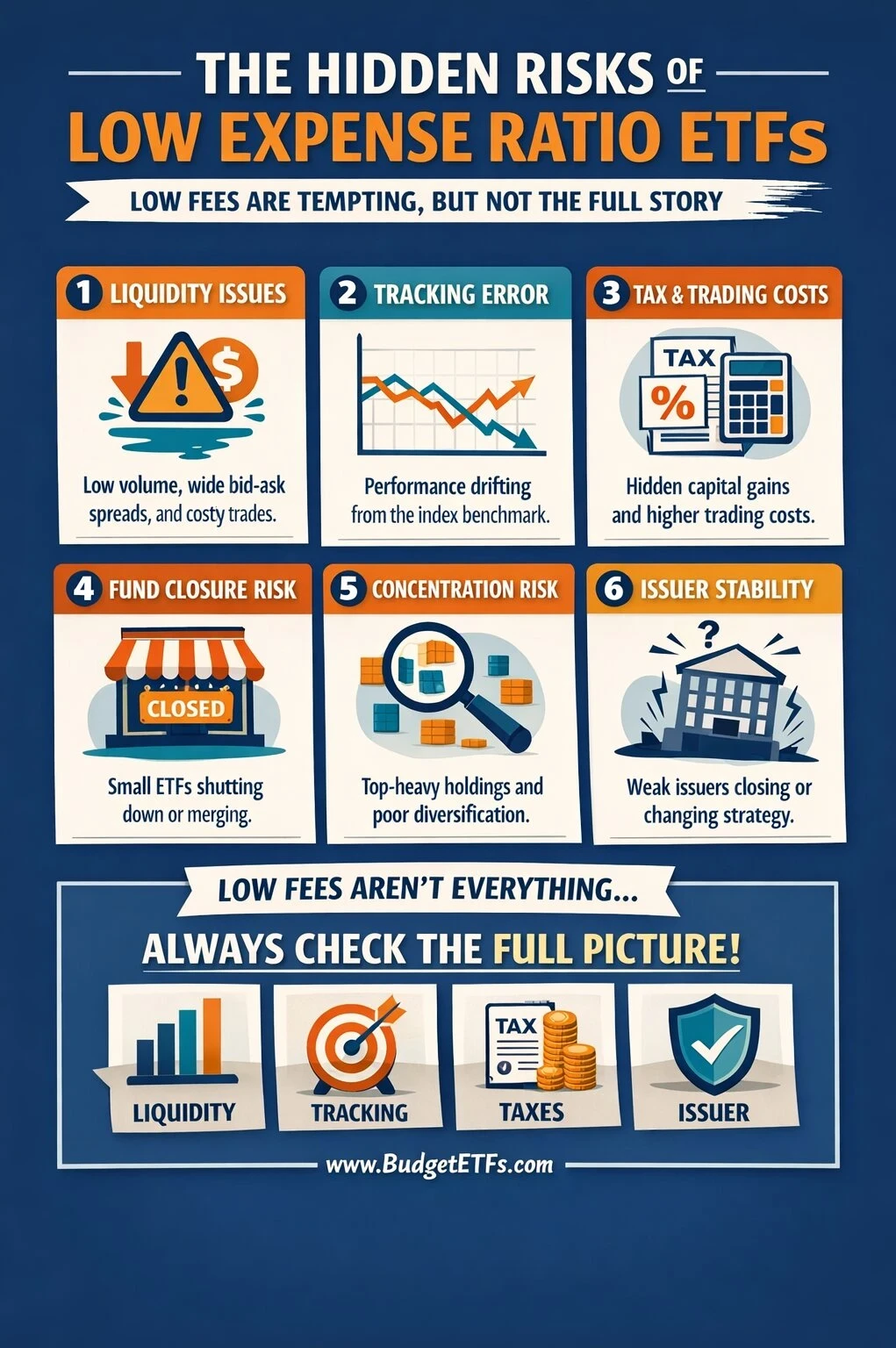
Some popular catch points can sneak up on investors who focus just on low expenses. Here are the issues I’ve run into most often when checking out ultralow-cost ETFs:
- Liquidity Shortages: Some low-cost ETFs have low trading volumes and wider spreads, which can make getting in and out tricky or expensive.
- Tracking Error: ETFs that slash costs may cut corners on index tracking, which means your returns might not match the benchmark as closely as you expect.
- Hidden Trading and Tax Costs: Lower management fees sometimes come at the expense of tax efficiency or higher trading costs inside the fund.
- Quality of Holdings: Funds chasing lower expenses may hold fewer securities or focus on more volatile parts of the index.
Liquidity Issues: What to Look Out For
Liquidity just means how easily you can buy or sell an ETF without causing its price to jump around. Low-volume ETFs often have wider bid-ask spreads, which eat into returns. Sometimes, a fund’s expense ratio is super low because no one is really trading it; you end up paying more than expected just to make a simple trade.
Checking average daily volume and spread size on a platform like TradingView is pretty handy for this. If a fund changes hands by only a few thousand shares a day, it’s worth considering if the low expense ratio is offset by the risk of getting stuck in a trade or paying a premium to buy or sell. Also, you might notice that some funds that look cheap on paper are actually more expensive to own because of this illiquidity.
Tracking Error: Performance Might Not Match the Index
The goal of most ETFs is to track an index as closely as possible. When you chase ultra-low costs, the fund might have fewer resources for rebalancing or use sampling strategies that don’t mirror the index closely. This can mean disappointing performance, even when the market is up. Some fund managers just aren’t as good at keeping performance in line with the stated benchmark.
It’s super useful to read up on tracking error in fund documents or use resources that track historic returns compared to the benchmark. There’s a deeper analysis of how these trends play out at ETF expense ratio trends for those wanting to get in the weeds. A consistent tracking error, especially if it gets worse over time, could signal issues with the fund’s tracking strategy or internal operations.
Tax and Trading Costs In The Background
Low-expense-ratio funds may use trading strategies that cause more capital gains for shareholders, or they may be less tax efficient. These costs aren’t always obvious upfront, and sometimes show up in your after-tax returns at year’s end. A fund that has to rebalance in an inefficient way due to its structure might hit you with a surprise tax bill. This is especially common in niche or international ETFs.
Also, some funds with super low expense ratios might buy and sell underlying assets more often to keep tracking in line, leading to higher internal trading costs. These trading costs don’t show in the expense ratio but can eat away at performance. The article on analyzing ETF expenses breaks down more of these hidden costs worth checking out. If you’re an investor who values tax efficiency, it’s smart to track down the fund’s distribution policy before getting in.
The Impact of Fund Size and Sustainability
There’s a growing wave of new ETFs with rock-bottom fees, often trying to undercut the competition to attract assets. But if they can’t grow big enough, those funds might close and leave investors needing to move their money quickly or deal with potential tax consequences. Watching a fund’s total assets under management (AUM) helps flag this risk. ETFs under $50 million in assets are at higher risk of closing shop if they don’t become profitable for the issuer.
If a fund shuts down, investors typically receive cash at the current market value, but there might be an unplanned tax hit if you hold the ETF in a taxable account. It’s worth checking if the fund has long-term sustainability or if it’s a new launch racing to build a track record. Larger, established funds are generally safer choices for long-term, hands-off investors.
Quality of Index Replication and Portfolio Concentration
Some cheap ETFs achieve lower costs by holding only a fraction of the securities in the index (this is sometimes called sampling). This can increase risk if key sectors or stocks become overweight, and you might not even realize your exposure is shifting. Concentrated portfolios might end up moving differently from the index, especially in volatile markets. Always check the number of holdings and the top holdings list to get a sense of how “representative” the fund really is.
Diversification is still key to risk control. If you notice that the top 10 holdings make up more than 40% of the fund, you might actually be taking on more risk than you planned.
Issuer Risk and Incentives
Big players like Vanguard and BlackRock can easily support ultra-low expense ratios because of scale. Smaller ETF issuers don’t always have that comfort and may make changes to their investments, merge funds, or tweak index strategies to keep costs down, which can lead to a bit more risk if you’re not paying attention. Reliability and reputation of an issuer matter more than fee wars alone.
It’s smart to stick with issuers that have a strong history of standing behind their products, offering transparency, and providing good support if the fund changes or is closed. If you’re interested in newer or niche ETF providers, take extra time to check in on how frequently they shuffle or close products, as this can introduce more uncertainty to your investment plan.
Quick Checklist: Evaluating a Low Fee ETF for Hidden Risks
Here’s a quick, practical list I use before picking a low-expense ETF. It saves me headaches down the road:
- Check trading volume and bid-ask spread on a site like TradingView.
- Look up assets under management (AUM) to see if the fund is established.
- Compare historic returns and tracking error versus its benchmark.
- Review holdings for overall diversification.
- Read the tax information and distribution history in the fund documents.
- Check for any signs that the issuer might merge or close funds frequently.
FAQs on Low Expense Ratio ETFs
Does a low expense ratio mean a fund is always a better deal?
Lower fees are important, but not the only thing that matters. Other costs, tracking error, and fund health need to be checked too. Sometimes, a fund with a slightly higher fee might actually leave you with more money in the long run.
Can ETFs with very low fees close suddenly?
Yes, some thinly traded or small asset ETFs launch with low fees to attract buyers, but might close if they don’t gather enough assets. Usually, investors get their money back at the market value, but it can be a hassle, especially for taxable accounts.
How much tracking error is too much?
It depends on your goal. For core index funds, anything more than 0.1% to 0.2% annual tracking error is a warning sign to dig in deeper. Niche funds might have more wiggle room, but more deviation isn’t always good.
What’s the best way to buy low-cost ETFs?
Using a reliable platform is super important for execution and research. I use eToro for easy ETF investing and TradingView to compare real-time spreads, charts, and volume for different ETFs. Both tools make it easy to size up trades and keep tabs on liquidity.
Wrapping Up: Striking the Right Balance
Chasing the lowest possible ETF fees is tempting, but not all savings are worth the downside. Considering liquidity, tracking error, tax impact, and issuer reliability helps investors build portfolios that deliver both long-term value and a smoother ride. Careful research is really important for finding ETFs that work for your situation, beyond just low expense ratios. Using resources like TradingView for data and checking issuer reputation can help take the guesswork out of picking low-cost ETFs that you can hold with confidence. It all comes down to staying sharp, reading the fine print, and refusing to let low fees distract you from the full picture of risk and reward.